Skip to Content

Weekend

P5119551OLYMPUS DIGITAL CAMERA
OLYMPUS DIGITAL CAMERAOLYMPUS DIGITAL CAMERAOLYMPUS DIGITAL CAMERAOLYMPUS DIGITAL CAMERAOLYMPUS DIGITAL CAMERAso-this-week-was

I received a lot of emails… from you! It’s not rare that I answer a few emails a week from my readers but over the past 7 days, my “to answer” folder has been brimming with questions. I answered one or two and three or four more would pop into my inbox. The questions were unexpected too. They varied from tips for starting a blog to a curriculum for a novice sewer and pitches for future posts. So motley were the questions, like a bag of M&Ms, that it made me think about the posts on this blog for the next couple of months. I am the queen of many things, especially a calendar, and topics for June and July have already been decided. But maybe there is something that you want  to learn about that I can help you with. If that’s the case, here’s your chance to speak up. Is there something you want to me to explain? Pattern making tips? 10 things about me? Construction rules?

What I’ve Made: Ohhh Lulu Bra

OLYMPUS DIGITAL CAMERA

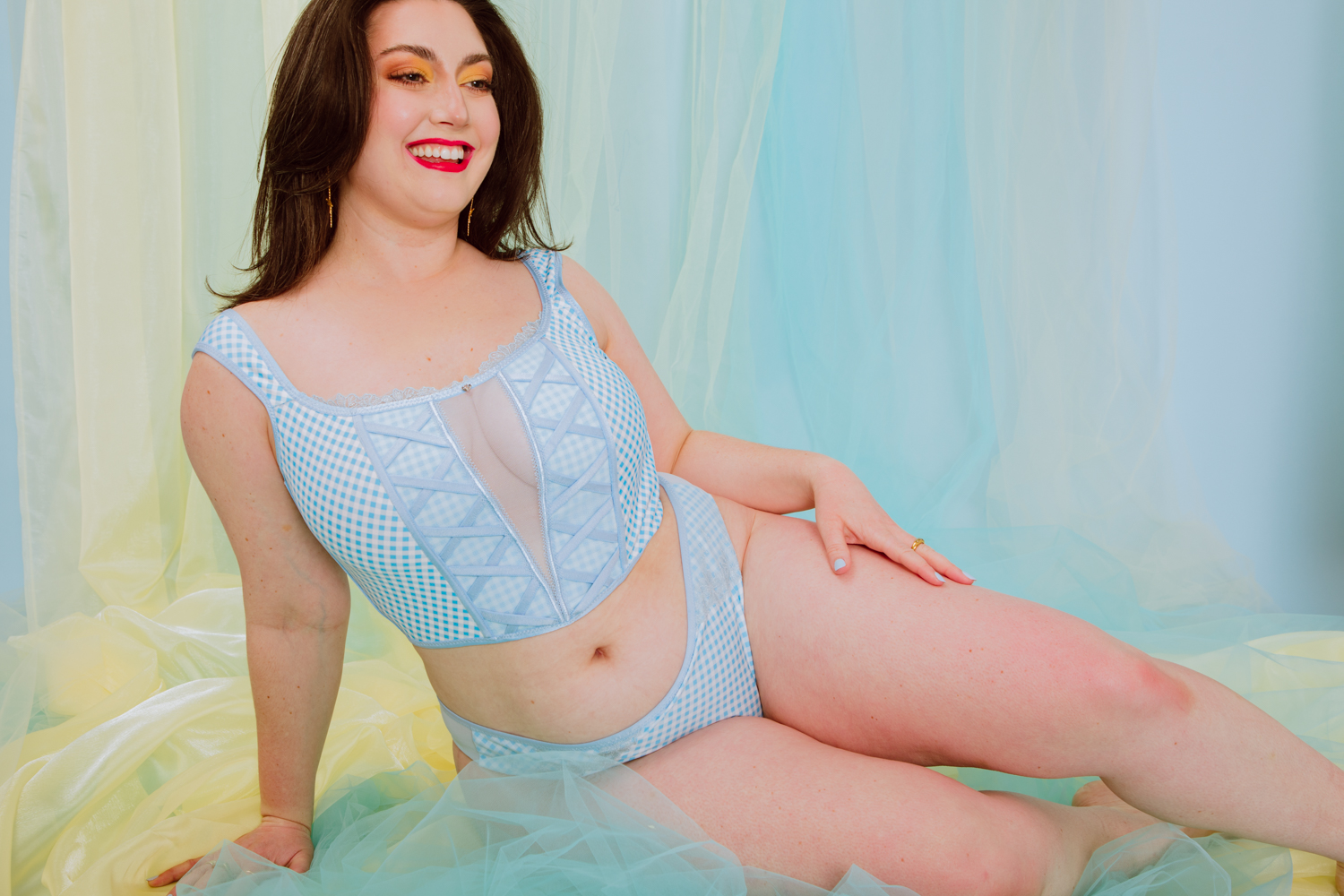
I thought this was my best bra but I was wrong – this is my best bra yet.

Not that I have enough projects to finish but when Ohhh Lulu released its new collection of bras and undies, Bambi caught my attention. Up until this point, all of the bras I had sewn were of cups/cradles variety. These types of bras present more of a fitting challenge than a soft bra/bralette and appeal to my masochistic pattern making side. It may sound weird but I love making a bra, it not fitting somewhere, and then going back to my manuals (Beverly Johnson’s or Norma’s) and figuring out why and how to correct the fit issue. That’s how I’ve learned so much over the past year – by trial and error. But in my day-to-day life, soft bras/bralettes make up about 60% of my intimates wardrobe. So to become a more well rounded bra maker, I gave Bambi a try.

The end result was an alarming, astonishing, and awe-inspring undergarment that was simple with a shot of brio. I didn’t expect it to be either. My intention going into this project was, sure, I’ll test it out, right a review, and get on with my other bra making toils and endeavors. But when I finished and took a step back to look at it, I thought, holy crap, I must make more; I need to make more! The fit is spot on too. This will be the perfect pairing for my summer tees and dresses.

OLYMPUS DIGITAL CAMERA  OLYMPUS DIGITAL CAMERA

page-advertising-title

FABRIC Because the suggested fabric is a woven, I chose a rigid galloon lace for the self and a 15-denier tricot for the lining. Technically, I didn’t need to line the bra (linings are used to stabilize cups and cradles, which are usually made with stretchy fabrics) but I chose to for comfort (tricot is softer than lace), to protect the delicate lace from wear and tear, and for coverage (so that it wouldn’t be as sheer).

ELASTIC I used a 1/4″ elastic at the top and a 3/8″ elastic at the bottom of the bra. When I first started sewing lingerie, I used a picot edged elastic that’s was labeled as lingerie elastic. But the recovery on it is not good and after a few wearings and hand washings, it’s dead. When I inspected my RTW bras, I saw that the elastic used are much sturdier and have a tighter tension. I realized that in order to make a functional bra that can withstand movement throughout the day, body sweat, and multiple washings, you really need a good quality elastic like these. Since making this switch, my bras have not only performed better but they look less homemade.

I used the fabric’s wide scalloped edge as a design detail at the bottom of the bra. To accommodate the scallops, I extended the pattern and applied the elastic at 2 inches above the lowest point of the scallop. Do you see the side seams and the cup seam? No and because I “matched” the scallops at each seam. Go Maddie!

STRAPS The straps were upcycled from an Anthropologie bra I no longer wear. In my opinion, the pop of color makes the bra.

I’ve always had a hard time sewing a clean bartack when attaching the straps. So I was delighted to read an alternative method in Norma’s ebook - a box stitch. It’s much cleaner and much, much easier to sew. Plus, it gives a couture touch to the bra, don’t you think?

The back straps extend to the bottom of the elastic to provide better support. It would have been cleaner to insert it into the elastic but the orange would have been noticeable/visible on the exterior.

SEAM-FINISH Many of my soft bras finish the seams with tricot binding that is folded in the center and then applied. Even though I have a delicate hand when it comes to sewing, I struggled with creating this type of binding. I didn’t get frustrated though – the mass manufacturing world has a machine just for making binding – and I came up with another solution – I applied the binding using this technique.

THINGS-I'M-STILL-STRUGLING-WITH I still have not found a solution to skipped stitches when applying the hook and eye closure. I have tried every needle, thread, tension, and presser foot. Nothing works. I’ve been applying hooks and eyes with a straight stitch and to be honest, I don’t think it looks bad, homemade, or lesser quality. The hooks and eyes that I buy are finished at the top and bottom edge so that’s one less step for me.

What do you think? My best bra yet?

OLYMPUS DIGITAL CAMERA

OLYMPUS DIGITAL CAMERA

Book Review: Demystifying Bra Fitting and Construction

norma

I began sewing lingerie about a year ago. Actually, I lied, I began thinking about sewing lingerie about a year ago. Sewing only woven fabrics up until that point, I had limited experience with elastic, hooks & eyes, tricot, ect. Yes, I worked in technical design for the two years prior and for one of those years, I handled intimates, but the information I learned about the product was theoretical – it was knowledge I learned from other tech designers and through the trade – not by actually sewing a bra and learning from mistakes.

Since last summer, I have picked up many tips and tricks through books, sew alongs, articles, and blogs. I have gained the most knowledge though by studying information, which even went as far as making flash cards that I flipped through during breakfast, lunch, or dinner, and then applying it to my projects. Beverly wrote in her manual that a scoop back band provides the most support – so I wrote it wrote it down, recited it over and over, and then did – I drafted a scoop back, sew up a bra, and wear tested it to see if she was correct. Knowledge to practice, knowledge to practice – that was and still is my motto.

My latest piece of knowledge was from Norma’s recently released Ebook, Demystifying Bra Fitting and Construction. I discovered Norma and her brand, Orange Lingerie, a long time before I started following her. I don’t remember where or when that was – what I remember is when Amy interviewed her back in January and I clicked to her site and thought, “I know her!”

Norma, who sewed and designed from age 9 until she graduated from college, put the hobby aside to pursue a career in finance. In 2010, she left her position at a major Wall Street firm to study custom bra making (she attended Beverly Johnson’s Bra Making School!). Today, she owns Orange Lingerie, a custom made bra company that provides individually tailored bras. Through Norma’s precise measuring and fitting a close-to-perfect fitting bra is almost guaranteed.

Over the past couple of weeks, I’ve been reading, rereading, and virtually highlighting (I love this feature of the Kindle) important snippets of her book. So much was covered in Beverly Johnson’s manual and because Norma studied under her, I was looking for overlapping information. But there wasn’t any. Because I have read many bra making books, the beginning was basic – the anatomy of a bra, tools used for sewing bras, and how a bra should fit. But that information is necessary to include because just like an introduction or a conclusion in an essay, it makes the rest of the book understandable to people who haven’t had as much experience as me. I got really deep into the book in the construction chapter. I’m still trying to fine tune my skills and I found a lot of information that I could put to practice (knowledge to practice – remember, that’s my motto). How to apply the elastic on a scoop back, how to draft a facing pattern for the bridge, how to ensure symmetry at the top of the bridge, and the stitch width of both the first and second pass of elastic – she covered all of this and more. One of my favorite tips, and I’m sure all of the OCD seamstresses out there will love this too, was, “…no one but you will examine the bra’s topstitching from under your sewists microscope. The only reason to tear out topsitching is if (a) there is an obvious fold or pucker in the fabric, (b) there is loose seam allowance on the wrong side of the fabric or (c) it looks bad from 3 feet away.” I’ve been reciting “three feet away” a lot because I have an unnecessary urge to make my topstitching perfect. Life and bras are so much easier at three feet away!

Norma’s book made me a more well-rounded bra maker but it is her that inspires me. She worked a 9-5 just as I do and threw it all in to pursue her passion. Not many people have the balls to do that and I commend her for it.

WIP: The Jumper Pattern

OLYMPUS DIGITAL CAMERA

Have you been asking yourself that lately, “What’s up with the jumper pattern?” In addition to the question “who am I?”, I ask this question every day.

The answer is it’s coming along.  I learned a huge lesson on sizing when I created my first pattern so I’m taking extra steps to ensure that this one fits many sizes, not just your children. Using the pattern for the jumper that Becky wore as a template, I made a few changes to it so that it would fit a variety of sizes (example: adding more shape in the hips, moving the bust darts, reshaping the front and back neckline). I fit that pattern on a fit model at work, who wears a size 6 (or small) in RTW, and then altered the pattern accordingly. The jumper you see in the photo above is the final fit sample/toile. Why didn’t I use muslin for the fabric? Because why they hell shouldn’t you use a cute fabric during the fitting process?

So onto grading I go. I’ve had and still have a few big projects that I’ve been working on since Amerson came out but those are coming to an end, which means I will be in full on jumper-pattern-mode for the next month or so.  I’m projecting a mid June/early July release date. Excited?


      I can't believe MEGAN hasn't repeated one outfit for MMM. You go girl!


      See what AMY has been cooking up. It doesn't have anything to do with food either!


      The perfect spring dress, SOPHIE'S week two Project Sewn is amazing.


      I'm totally jealous of HEATHER'S sewing studio. Heather, may I come live (and sew) with you?


      LIZ from the blog A Good Wardrobe gave her Five Tips For Beading. Wow, this girl knows what she's talking about! Thanks Liz!